
Brown County Ohio Public Records offer full transparency into government operations, legal proceedings, property ownership, and vital life events. These records include birth certificates, marriage licenses, criminal histories, court case files, property deeds, tax assessments, and business registrations. Every document follows Ohio Revised Code §149.43, which guarantees public access unless specifically exempted by law. Residents, genealogists, real estate professionals, and legal researchers rely on these records for verification, due diligence, and historical research. Most requests can be submitted online with PDF delivery within 48 hours, while in-person visits provide immediate access during business hours at offices in Georgetown, the county seat.
Types of Public Records Available in Brown County, Ohio
Brown County maintains a wide range of public records across multiple departments. Vital records like certified birth and death certificates are issued by the County Health Department. Marriage licenses and divorce decrees are processed through the Clerk of Courts. Property-related documents—including deeds, mortgages, liens, and tax assessments—are managed by the Recorder’s Office and County Assessor. Criminal records, arrest logs, and inmate status reports are maintained by the Sheriff’s Office. Business filings, contractor bonds, and professional licenses are handled by the County Clerk. Each agency follows strict retention schedules and privacy rules, especially under Ohio’s R-10 regulations for sensitive data like booking photos and juvenile records.
Vital Records: Birth, Death, Marriage, and Divorce
Certified copies of birth and death certificates are available only to eligible individuals, such as the person named, immediate family members, or legal representatives. Requests must include valid ID and proof of relationship. Marriage licenses are public upon issuance, but certified copies require the couple’s names and wedding date. Divorce decrees are part of court records and can be accessed through the Clerk of Courts. Processing times vary: online requests take 24–48 hours, while walk-ins may receive documents the same day. Fees range from $15 to $25 per certified copy, payable by cash, check, or credit card.
Property and Land Records
Property records in Brown County disclose ownership history, legal descriptions, parcel numbers, assessed values, and recorded liens. The County Recorder maintains deeds, mortgages, easements, and plat maps dating back over a century. The Assessor’s Office provides tax valuation data and exemption statuses. Most land records are digitized and searchable via the “County Fusion Search” tool on the Recorder’s website. Users can generate chain-of-title reports, view scanned document images, and download PDFs instantly. For certified copies or notarization, visit the office at 800 Mt. Orab Pike, Suite 151, Georgetown, OH 45121.
Court and Criminal Records
All cases filed in the Brown County Court of Common Pleas, Municipal Courts, and Probate Court become permanent public records. These include civil lawsuits, criminal indictments, probate matters, and small claims. Docket entries, pleadings, sentencing memoranda, and final judgments are stored both physically and digitally. The Clerk of Courts updates the online database daily, though new filings may take 24–72 hours to appear. Arrest logs and booking information are released by the Sheriff’s Office upon written request, excluding protected details under R-10 privacy rules. Felony and misdemeanor convictions are listed in the county offender registry, which is updated weekly.

Business and Professional Licensing Records
The County Clerk processes business registrations, fictitious name filings, and contractor bond submissions. These records confirm active status, registration dates, and responsible parties. Professional licenses—such as those for contractors, appraisers, and notaries—are verified through state and county databases. While some records are searchable online, others require a formal request form submitted in person or by mail. All business filings are subject to Ohio’s public record laws and must be made available within five business days of a lawful request.
How to Request Brown County Ohio Public Records
Residents can obtain public records through three main methods: online portals, in-person visits, or mailed requests. Most agencies offer digital submission forms that return PDFs within 48 hours. For urgent needs, visiting the relevant office during business hours allows same-day access. Written requests must include the requester’s name, contact information, specific record details, and purpose of use. Ohio law requires agencies to respond within a reasonable time—typically five business days—and provide an estimated cost if fees apply. Denials must cite a specific exemption under state law.
Online Request Portals
Brown County provides several online tools for record searches. The Clerk of Courts offers a real-time docket search with case numbers, parties, and dispositions. The Recorder’s “County Fusion Search” returns instant document images for property records. The Sheriff’s Office publishes an inmate lookup tool updated every 12 hours. Each portal is free to use, though certified copies incur standard fees. Users should verify URLs through official county websites to avoid third-party scams.
In-Person and Mail Requests
For records not available online or requiring certification, visit the appropriate office in Georgetown. The Clerk of Courts is open Monday through Friday, 8:30 a.m. to 4:30 p.m. The Recorder’s Office operates from 8:00 a.m. to 4:00 p.m. Same-day service is available for walk-ins who complete the standard request log. Mailed requests should include a self-addressed stamped envelope, payment, and a completed form. Processing may take 7–10 business days. Always call ahead to confirm hours and required documents.
Fees and Payment Options
Fees vary by record type and format. Certified copies cost $15–$25. Non-certified prints are $0.10–$0.25 per page. Electronic deliveries are often free or discounted. Payment methods include cash, check, money order, or credit card (in person only). Fee waivers are not permitted under Ohio law, but indigent individuals may request reduced rates through a formal appeal. All charges must be disclosed upfront.
Brown County Public Records Directory and Search Tools
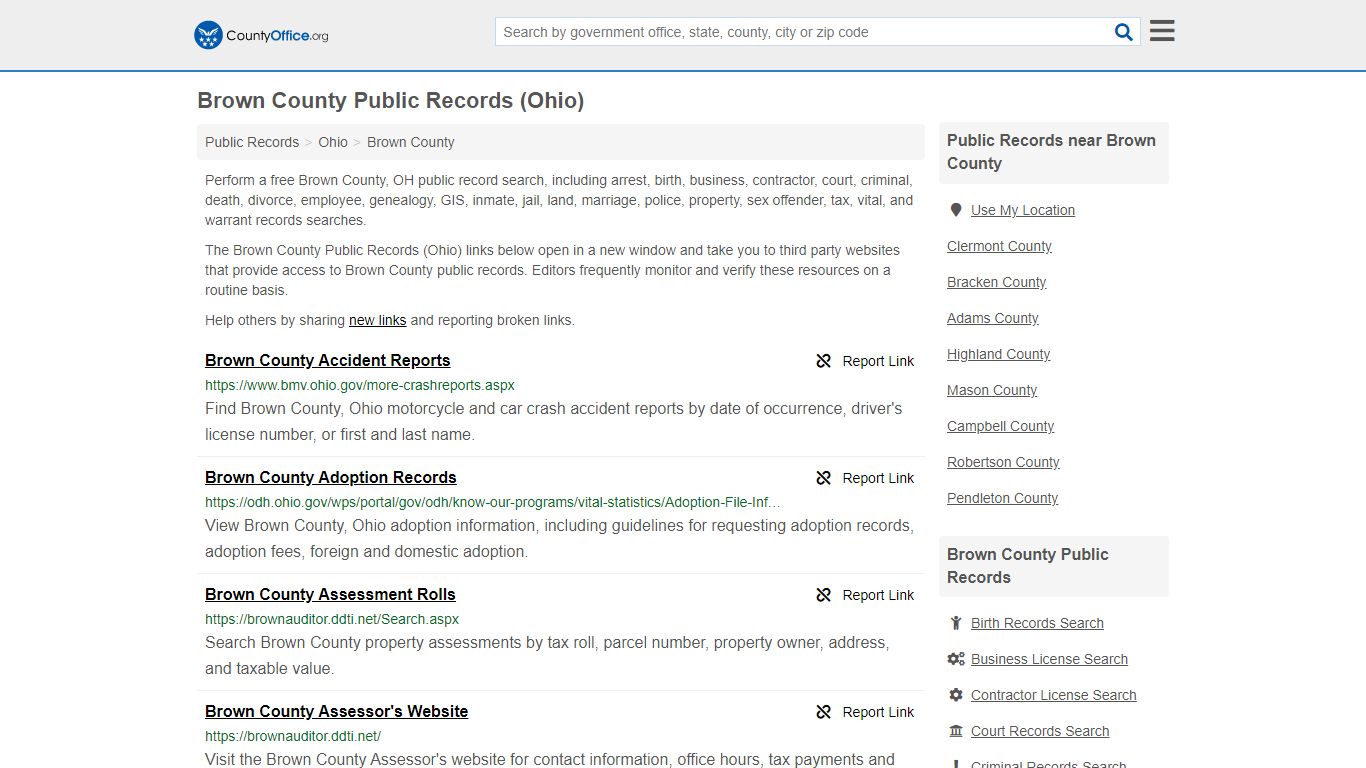
The Brown County Public Records Directory consolidates access points for all government-held data. It includes direct links to property tax rolls, vital statistics, inmate reports, court dockets, and licensing databases. Each entry is verified by volunteers who check URL accuracy, update frequency, and form requirements. Users can filter by jurisdiction (county, state, federal) and document type. This resource is ideal for genealogists tracing family history, investors evaluating real estate, and attorneys conducting background checks.
Third-Party Aggregators and Verification
Websites like OnlineSearches.com and StateRecords.org compile Brown County records into user-friendly interfaces. While convenient, these platforms are not official sources and may charge access fees. Always cross-check critical information with county offices. The County Office portal remains the most reliable free option, offering verified links and usage statistics that help agencies prioritize digitization efforts.
Privacy and Legal Restrictions
Not all records are fully public. Ohio law exempts certain information, such as Social Security numbers, medical records, and ongoing investigation details. Juvenile records are sealed by default. The Sheriff’s Office redacts sensitive data from arrest logs before release. Requesters must comply with usage restrictions—records cannot be used for harassment, stalking, or commercial solicitation. Violations may result in civil penalties or criminal charges.
Common Uses and User Scenarios for Brown County Records
Public records serve diverse needs. Homebuyers verify property titles and lien statuses before closing. Employers conduct background checks using criminal and court records. Genealogists reconstruct family trees with birth, marriage, and death certificates. Journalists investigate local government actions through meeting minutes and contract filings. Legal professionals use docket sheets to track case progress. Each user group benefits from the transparency and accountability these records provide.
Real Estate and Title Research
Before purchasing property, buyers request a title search to confirm ownership and uncover liens, easements, or tax delinquencies. The Recorder’s Office provides chain-of-title reports showing every transfer since the original grant. Title companies often handle this process, but individuals can perform their own search using online tools or in-person visits. Delays in recording may affect accuracy, so always verify recent filings directly with the office.
Background Checks and Employment Screening
Employers use Brown County criminal records to screen job applicants. The Sheriff’s Office offender registry lists convictions by name, date, and charge. For comprehensive checks, requesters combine local data with Ohio’s statewide criminal database. Note that arrests without conviction are not proof of guilt and must be handled carefully under fair hiring laws. Always obtain written consent from the individual before requesting records.
Genealogy and Historical Research
Family historians rely on vital records, probate files, and old court dockets to trace ancestry. Brown County archives contain documents dating back to the 1800s, many now digitized for online access. The Clerk of Courts maintains probate indexes that list wills, estates, and guardianships. Researchers should allow extra time for older records, as retrieval from offsite storage may take several days.
Official Contacts and Office Information
For accurate and up-to-date assistance, contact the relevant Brown County office directly. The Clerk of Courts handles civil, criminal, and probate records at (937) 378-6478. The Recorder’s Office manages land and property documents at the same number. The Sheriff’s Office provides arrest and inmate information. All offices are located in Georgetown, Ohio, and operate during standard business hours. Visit only during posted times to ensure staff availability.
Clerk of Courts
Address: 800 Mt. Orab Pike, Suite 151, Georgetown, OH 45121
Phone: (937) 378-6478
Hours: Monday–Friday, 8:30 a.m.–4:30 p.m.
Website: https://clerkofcourtsbrowncountyohio.org/
Brown County Recorder
Address: 800 Mt. Orab Pike, Suite 151, Georgetown, OH 45121
Phone: (937) 378-6478
Hours: Monday–Friday, 8:00 a.m.–4:00 p.m.
Website: https://www.browncountyrecorder.org/
Brown County Sheriff’s Office
Address: 240 W. Main St., Georgetown, OH 45121
Phone: (937) 378-4435
Inmate Lookup: https://www.browncountysheriff.org/
Hours: 24/7 for emergencies; administrative office 8:00 a.m.–4:00 p.m.
Frequently Asked Questions About Brown County Ohio Public Records
Residents often have questions about access, fees, privacy, and procedures when requesting public records. Below are detailed answers to the most common inquiries, based on Ohio law and Brown County policies. These responses reflect current practices as of 2024 and are designed to help users navigate the system efficiently and legally.
How long does it take to receive public records from Brown County?
Most online requests are processed within 24 to 48 hours, especially for digital records like court dockets or property deeds. In-person visits may yield same-day results if the document is on-site and staff are available. Mailed requests typically take 7 to 10 business days due to handling and postage. High-volume periods, such as tax season or court deadlines, can cause delays. Agencies must respond within five business days per Ohio law, even if the record isn’t ready. Always include a phone number so staff can contact you with updates or questions.
Can I get a certified copy of a birth certificate online?
No, Ohio law restricts certified vital records to in-person or mailed requests with proper identification. Only eligible individuals—such as the person named, parents, spouses, or legal guardians—can obtain certified copies. Online portals provide informational summaries but not legally valid certificates. To request a certified birth certificate, visit the Brown County Health Department with a government-issued ID and proof of eligibility. Processing takes 15 to 30 minutes during business hours. Fees are $25 per copy, payable by cash, check, or card.
Are arrest records public in Brown County?
Yes, arrest logs and booking information are public records unless sealed by court order or protected under R-10 privacy rules. The Sheriff’s Office releases names, charges, booking dates, and release status upon written request. However, booking photographs may be withheld if disclosure would interfere with an investigation or violate privacy rights. Juvenile arrests are not public. Requesters must specify the date range and individual’s name. False or misleading use of arrest data can lead to legal consequences.
Do I need to pay to search for property records online?
No, basic property searches on the Brown County Recorder’s “County Fusion Search” tool are free. You can view ownership, legal descriptions, and document images without charge. However, downloading certified copies or requesting notarized documents incurs fees—typically $15 to $25 per item. The Assessor’s website also offers free access to tax values and exemption statuses. Avoid third-party sites that charge for information freely available from county offices.
What happens if my public records request is denied?
If a request is denied, the agency must cite a specific exemption under Ohio Revised Code §149.43, such as ongoing investigations, personal privacy, or national security. You have the right to appeal the decision to the Ohio Court of Common Pleas within 30 days. Include your original request, the denial letter, and a statement explaining why the record should be public. Legal aid organizations may assist with appeals. Most denials are resolved through clarification or partial release of redacted documents.
Can businesses access public records for marketing purposes?
Yes, but with restrictions. Ohio law allows public records to be used for commercial purposes, including marketing and lead generation. However, using the data for harassment, stalking, or unsolicited contact violates state statutes. Real estate agents, insurers, and debt collectors commonly use property and court records legally. Always verify the accuracy of information before acting on it. Misuse can result in civil lawsuits or criminal charges under Ohio’s anti-harassment laws.
Are old court records available online?
Many historical court records are digitized and searchable, especially those from the 1980s onward. Older files, particularly pre-1970 probate and civil cases, may require in-person retrieval from archival storage. The Clerk of Courts estimates a 3- to 5-day wait for non-digitized documents. Genealogists and historians should call ahead to confirm availability. Some records have been transferred to the Ohio History Connection for preservation. Always specify the case number or party names to speed up the search.